Thinking in DRAW / Composable Methodology
In Olympe, application development is reimagined through a data-first and composable mindset. Instead of writing code in a linear, monolithic way, you build applications by assembling modular building blocks—making your solutions more flexible, reusable, and adaptable.
Code-as-Data
-
DRAW Generates Data, Not Code:
Projects, apps, screens, and functions defined in DRAW are stored as data, introducing the Code-as-Data notion. The Olympe Virtual Machine interprets this data and transforms it into a running application. It is possible to extend DRAW's capabilities using Olympe CODE, a JavaScript framework. -
Consistency and Agility:
By managing your application as data, changes can be applied consistently across the system, enabling rapid iterations and updates.
Thinking Composable
-
Modular Mindset:
Rather than focusing on a single, large codebase, you think in terms of independent modules. Each module can be developed, tested, and maintained separately. -
Reusability:
Components built in a composable way can be reused across multiple applications, reducing redundancy and enhancing scalability. -
Dynamic Composition:
The composable approach encourages building applications by combining different functional units—allowing you to mix and match features as needed.
Olympe Platform Architecture
The Olympe Platform enables modular, scalable application development by combining frontend apps, orchestrated backend services, and flexible integration capabilities.
- Frontend: Users interact via web/mobile apps, with secure HTTPS/WSS communication.
- Core Platform: Uses NGINX (web server), Kubernetes (orchestration), a Message Bus (real-time communication), and an Orchestrator with a Neo4j-based Composition DB to coordinate logic and data flow.
- Backend Services:
- Self-hosted: Organizations can run their own Node.js services integrated into the platform.
- Olympe-hosted: Scalable, managed backend services provided by Olympe.
- Integrations: Supports APIs, legacy systems, databases, file storage, AI, IoT, and identity providers (SSO).
- Flow: Frontend → Message Bus → Orchestrator → Backend (self/Olympe) → External systems → Response to frontend.
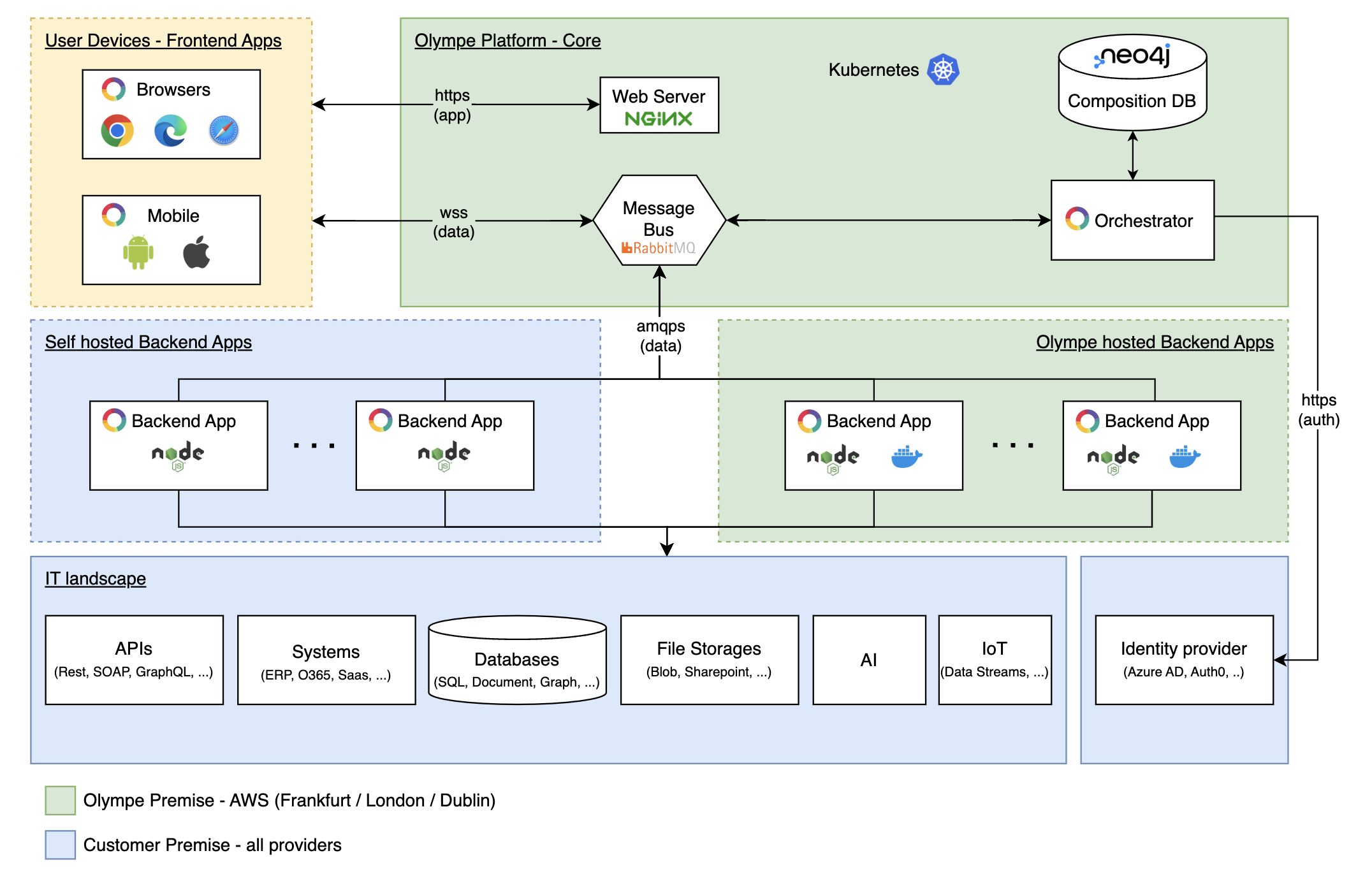
This architecture offers flexibility, performance, and extensibility for building modern, composable applications